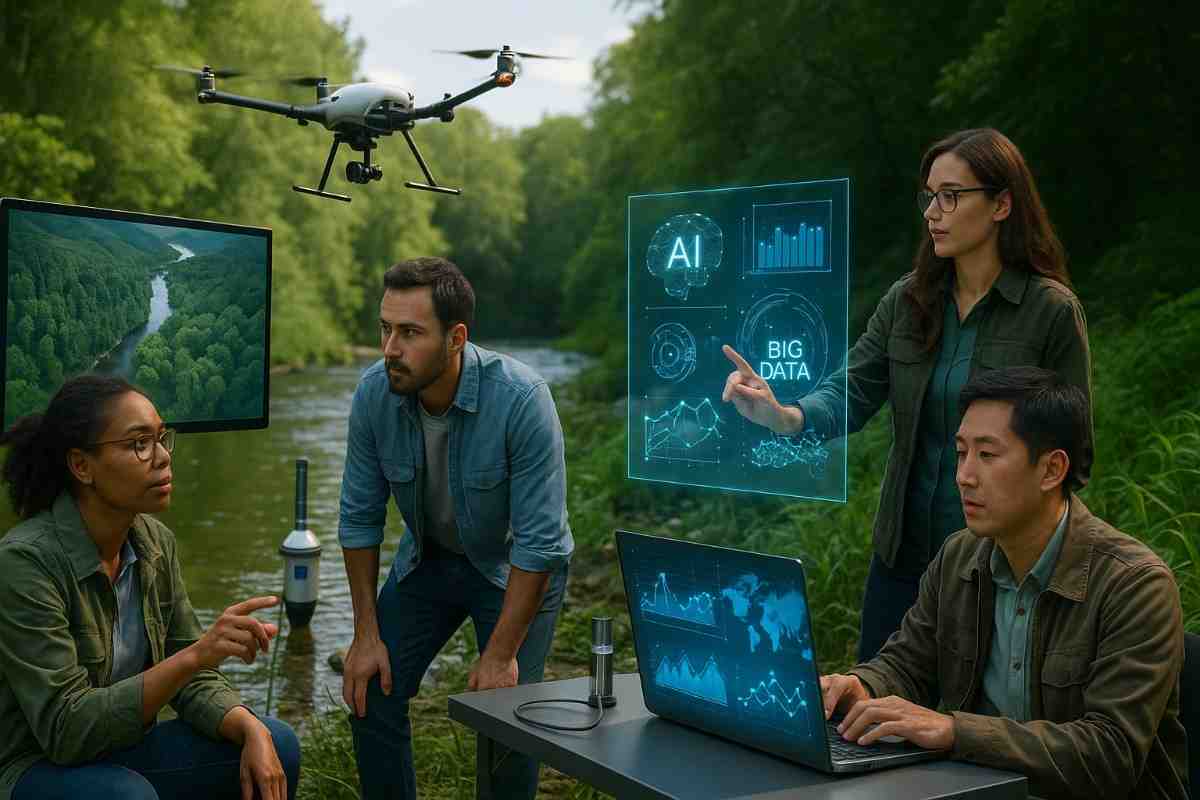
The environment is facing unprecedented challenges — climate change, deforestation, biodiversity loss, and pollution are reshaping ecosystems at alarming rates. Traditional research methods, while invaluable, often struggle to keep up with the scale and complexity of these problems. Enter Artificial Intelligence (AI) and Big Data — technologies that are revolutionizing the way scientists observe, analyze, and respond to environmental changes.
From monitoring endangered species to predicting natural disasters, AI and Big Data are providing insights that were once unimaginable. This article explores how these technologies are reshaping environmental research and driving solutions for a more sustainable future.
1. Understanding the Power of AI and Big Data in Environmental Science
AI refers to computer systems capable of performing tasks that normally require human intelligence — recognizing patterns, making predictions, and analyzing complex data. Big Data, on the other hand, is the ability to collect, store, and process vast volumes of information from diverse sources such as satellites, sensors, and social media feeds.
When combined, these technologies enable researchers to process environmental data in real-time, detect subtle patterns in climate or biodiversity, and predict ecological trends with remarkable accuracy. This marks a shift from traditional observation to proactive, data-driven environmental management.
2. AI in Climate Modeling and Weather Prediction
- Improved Forecasting Accuracy: Machine learning algorithms analyze decades of weather and climate data to predict rainfall, temperature changes, and extreme weather events more precisely.
- Early Warning Systems: AI systems detect anomalies and forecast disasters like floods, hurricanes, and droughts, helping communities prepare in advance.
- Scenario Simulation: AI-powered models test the effects of policy changes, emission reductions, or conservation strategies, guiding global decision-making.
3. Big Data for Environmental Monitoring
- Satellite & Drone Imagery: Massive image datasets are analyzed to detect deforestation, glacier melting, and urban expansion.
- Air & Water Quality Sensors: IoT devices collect pollution data that AI interprets to identify sources and trends.
- Ocean & Soil Monitoring: Real-time data from sensors track chemical levels, temperature shifts, and ecological health indicators.
These continuous data streams allow researchers to monitor the planet’s health at a global scale, identifying threats before they escalate into crises.
4. AI for Biodiversity and Conservation
- Species Recognition: AI models analyze camera trap and audio data to identify animals in the wild, even in remote regions.
- Population Tracking: Predictive analytics estimate species populations and migration patterns, informing conservation policies.
- Habitat Prediction: Algorithms identify suitable areas for reforestation and wildlife reintroduction programs.
These tools empower conservationists to act faster and smarter, directing resources where they can have the greatest impact.
5. Predicting and Preventing Natural Disasters
- Flood Management: AI combines rainfall, soil, and topographic data to predict flood zones and guide infrastructure planning.
- Wildfire Detection: Machine learning models analyze heat maps and vegetation dryness to detect early signs of fires.
- Earthquake Forecasting: AI studies seismic patterns to improve early warning systems and reduce casualties.
6. Resource Optimization and Sustainable Development
- Energy Efficiency: Smart grids use AI to predict demand, reduce waste, and optimize renewable energy sources.
- Water Management: Big Data helps track water usage, detect leaks, and ensure fair distribution in drought-prone areas.
- Precision Agriculture: Farmers use AI to analyze soil health, weather data, and crop conditions, minimizing pesticide use while maximizing yield.
7. Challenges of Implementing AI and Big Data in Environmental Research
- Data Quality and Availability: Incomplete or biased datasets can lead to inaccurate conclusions.
- Infrastructure Demands: High computing power and storage are needed to process global-scale environmental data.
- Ethical Concerns: The use of drones and surveillance data can raise privacy issues in some regions.
- Knowledge Gap: Integrating AI requires multidisciplinary collaboration between environmental scientists and technologists.
8. The Future of AI and Big Data in Environmental Research
The integration of AI, IoT, and Big Data promises a new era of environmental intelligence. As algorithms become more advanced, researchers will be able to create self-learning systems capable of monitoring entire ecosystems autonomously.
- Real-Time Monitoring Networks: Millions of sensors connected globally will provide continuous environmental updates.
- Predictive Conservation: AI will simulate ecosystem responses to climate change, helping scientists plan future interventions.
- Citizen Science Integration: Public participation through AI-powered apps will crowdsource valuable environmental data.
Conclusion: A Smarter, Sustainable Future
AI and Big Data are transforming environmental research from reactive observation to proactive preservation. By enabling faster analysis, predictive modeling, and real-time monitoring, these technologies are empowering humanity to respond to ecological challenges with unprecedented precision and speed.
As AI continues to evolve, it will not replace human insight but amplify it — allowing scientists, governments, and citizens to collaborate toward a more sustainable and intelligent planet. The fusion of technology and environmental science marks the beginning of a new era — one driven by data, innovation, and hope for a greener future.